Posts

Section 164 of Code of Criminal Procedure, 1973 (Cr.P.C.) – Explained!

Recording of confessions and statements: The confessional statements recorded under this section are substantive evidence but a non-confessional statement recorded under this section is not substantive evidence and it can be used for corroborating or contradicting the witness making such statement in the trial. The mode of recording a confession is different from that of other statements. This section applies only to confessions which are made out of free will and voluntarily. It is now a settled law that Section 164 does not merely deal with the manner of recording the confession and statements, but it also deals with their admissibility and relevancy as evidence in the trial. The Supreme Court has ruled that the confession or statement made to a Magistrate in course of police investigation must be reduced to writing and by virtue of Section 90 of the Evidence Act; the Magistrate would not be competent to give oral evidence of such statement having been made by the accused Sub-se...
Section 162 of Code of Criminal Procedure, 1973 (Cr.P.C.) – Explained

Statements to police not to be signed: Use of statements in evidence: This section protects the person making statement during police investigation under duress or inducement. The Code allows police officer to record statements of witnesses with a view to facilitating investigation of the offence. But if such statements are made under duress or inducement, they are rendered inadmissible in evidence because they cannot be said to be free and fair statements made voluntarily. As rightly pointed out by the Apex Court, the object of Section 162 is “to protect the accused both against overzealous police officers and untruthful witnesses.” It cannot be used for corroborating a witness but it can certainly be used to contradict him by a police statement. Where a person appears as a defence witness in a trial, his former statement made before the police cannot be used for contradicting him because it would be against the accepted norms of justice to allow a witness to be contradi...

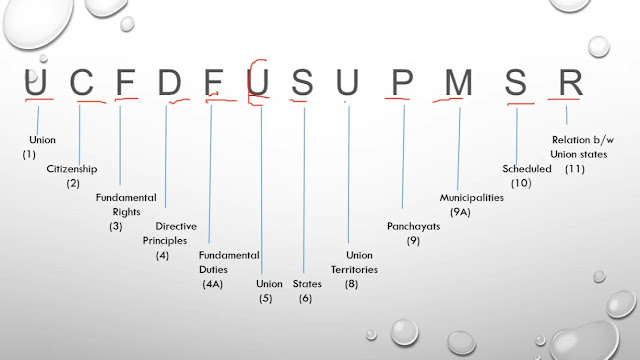
Constitution bare act classification

Image

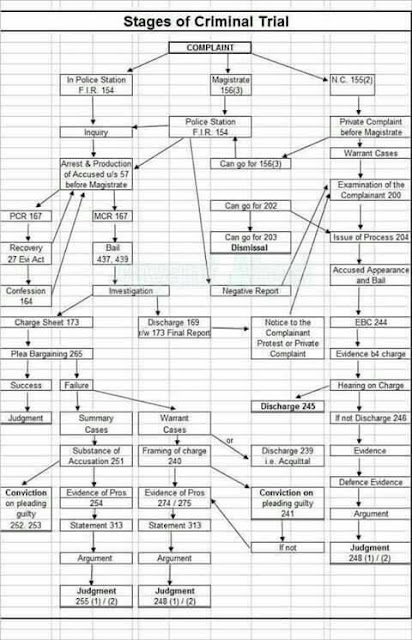
Stages of criminal trial

Image

When there be quashing of F.I.R?

1. Where the allegation made in the First Information Report or the Complaint , even if they are taken at their face value and accepted in their entirety do not prima facie constitute an offence and make out a case against the accused. 2. Where the uncontroverted allegation made in the FIR or complaint and the evidence collected in support of the same do not disclose the commission of any offence and make out a case against the accused . 3. Where the allegation in the FIR do not constitute a cognizable offence but constitute a non cognizable offence , no investigation is permitted by a police officer without an order of a Magistrate as contemplated under section-155(2) 4. Where the allegation made in the FIR or complaint are so absurd and inherently improbable on the basis of which no prudent men can ever reach a just conclusion that there is sufficient ground for proceeding against the accused. 5.where there is an express legal bar engrafted in any provision of the code against th...

When inherent can and should be exercised to quash the proceeding?

1. Where it manifestly appear that there is legal bar against the institution or continuance. 2. Where the allegation in the first information report or complaint taken at its face value and accepted in their entirety do not constitute the offence alleged. 3.where the allegation constitute an offence, but there is no legal evidence adduced or the evidence adduced clearly or manifestly fails to prove the charge

INHERENT POWER OF HIGH COURT

Inherent power is an exception not the rule, it is not conferred upon the body rather they exist per se because the body exist with the purpose. It only saves the inherent power which the court possessed before the enactment of code. It merely acknowledges and declare the existence of such power . It envisage three circumstances under which inherent power may be exercised 1. To give effect to an order under the code . 2. To prevent abuse of the process of court 3. To otherwise secure the ends of Justice. Section-482 cr.p.c uses the word Nothing in the code instead of Notwithstanding . The inherent power are saved by section-482 from any adverse effect by the express provision of cr.p.c if the word Notwithstanding being used it would amount to conferring and overriding power of the High Court. ~~firstly, inherent power cannot be conferred ~~secondly, it is in the very nature of the things that inherent power are complementary in the express provision and not against the provision...

STAGES OF CRIMINAL PROCEEDINGS

Pre-trial proceedings   This is the first stage of criminal proceedings. The objective of this stage is to ascertain, whether the suspicion of a committing a crime by a certain person is sufficiently substantiated in order to file an indictment to court. In this stage it is necessary to find and obtain evidence proving the guilt of the accused person, as well as other evidence disproving his guilt. The outcome of the whole criminal proceedings depends on correct execution of pre-trial proceedings. There is a new option to negotiate an agreement on the guilt and punishment in this stage between the accused person and public prosecutor.    Tasks in pre-trial proceedings:   - to secure the groundwork basis for the decision, whether to file an indictment and let the court deal with the case or to waive further criminal prosecution of the person concerned, - to ascertain all circumstances important for deciding on the criminal offense, its perpetrator, punishment a...

IS IT TRUE THAT FIR AND POLICE COMPLAINT ARE DIFFERENT

Is It True That FIR and Police Complaint are Different? FIR is a First Information Report. It is related only to cognizable (criminal) offences. On the other hand, police complaint can be cognizable or non-cognizable offences. FIR and Police complaint are two different terms with different meanings. Though they are related to complaints, they have different offenses and complaints where FIR and police complaints are registered accordingly. FIR is a First Information Report, a complainant who is aware of the offense, as an eye witness and as hearsay account, lodges an FIR. It is information given to the Police Officer. FIR is a very serious registration that one can make. It should not be gossip and that should be traceble, and after the complete investigation the source takes the responsibility. An irresponsible rumor should not result in the registration of a FIR. It is mandatory to give a copy of the first information report (as recorded by police) to the complainant or the inform...

SPECIAL MARRIAGE ACT

10 THINGS EVERY INDIAN SHOULD KNOW ABOUT THE SPECIAL MARRIAGE ACT,1954 ‘Marriage’ is considered a sacred institution in our Indian subcontinent. It is an integral part of our culture. India is a diverse country and thus has people from a number of religions and cultures, residing here. When it comes to marriages in India, arranged marriages are considered the best way to get a boy and a girl to tie the marital knot. Indian parents are the ones who take utmost interest in it, right from the girl or boy they want their child to get married to, till the date and time of marriage. This is so because there prevails this thinking that they are a lot wiser and experienced than their children, and will decide the best for them. Indians consider marriage as an auspicious culmination of two souls, that they decide every ritual of marriage according to the astrological positioning of the stars of the bride and the groom. Earlier, marriages were commenced where the bride and the groo...

UNIFORM CIVIL CODE

Why Uniform Civil Code is necessary for India? Uniform Civil Code is defined in our Constitution under Article 44 which states that it is the duty of the state to secure for the citizens a Uniform Civil Code throughout the territory of India. Now question arises what is Uniform Civil Code? It is the common set of governing rules for all citizens of India which refers to replace the personal laws (based on religious scriptures and customs). These laws are famous from public law and cover marriage, divorce, inheritance, adoption and maintenance. In fact Goa is the only state which has a common family law and 1954 Special Marriage Act allows any citizen to marry outside the realm of any special religious personal law. Now let us see our past from where uniform laws are originated. The British Government in 1840 on the basis of Lex Loci report had framed Uniform laws for crimes, evidences and contract but personal laws of Hindus and Muslims are left by them somewhere intentionally. On t...

🚨*CIVIL TRIAL*🚨

🚨*CIVIL TRIAL*🚨 Trial of civil suit and follow the procedure stage by stage as under; 1. Plaintiff has to file the plaint complying the provisions in all respect as contemplated under Order 4 r/w Order 6 and 7 of the code. 2. Plaintiff has to issue summons within 30 days from the institution of suit. 3. After the service of summons defendant has to file his written statement within 30 days from the receipt of summons as per Order 8 R 1 of the code 4. No further time exceeding 90 days after date of service of summons be extended for filing written statement as per proviso to Order 8 R 1 of the code. 5. Within 10 days from the filing of written statement court has to examine the parties so as to explore the possibilities of compromise in between the parties and to refer the matter of settlement under section 89 of the code. 6. If parties fail to compromise the matter then court has to keep the matter for discovery and inspection within the time span of 7 –...

JUDICIAL REVIEW AND JUDICIAL ACTIVISM

Judicial Review and Judicial Activism Judicial Review refers to the power of judiciary to review and determine the validity of a law or an order. On the other hand, Judicial Activism refers to the use of judicial power to articulate and enforce what is beneficial for the society in general and people at large or judicial activism means the power of the Supreme Court and the high court but not the sub-ordinate courts to declare the laws as unconstitutional and void. Judicial Review: India has an independent judiciary with extensive jurisdiction over the acts of legislature and executive. Judicial review can be defined as the doctrine under which legislative and executive actions are subject to review by judiciary. It is generally considered as a basic structure of independent judiciary (Indira Gandhi vs. Rajnarain case). However, judicial review can be classified into three categories-reviews of legislative actions, review of judicial decisions, and review of administrative action. ...

MATERNITY BENEFIT (AMENDMENT) BILL, 2016

Maternity Benefit (Amendment) Bill, 2016 passed in the Parliament  The Bill seeks to increase maternity leave available to working women from the current 12 weeks to 26 weeks for the first two children The Lok Sabha has passed the Maternity Benefit (Amendment) Bill, 2016 today. The Bill had already been passed by the Rajya Sabha during the Winter Session. With this, the Bill stands passed in the Parliament.  The Bill seeks to amend the Maternity Benefit Act, 1961 to provide for the following:- (i) Maternity leave available to the working women to be increased from 12 weeks to 26 weeks for the first two children. (ii) Maternity leave for children beyond the first two will continue to be 12 weeks. (iii) Maternity leave of 12 weeks to be available to mothers adopting a child below the age of three months as well as to the “commissioning mothers”. The commissioning mother has been defined as biological mother who uses her egg to create an embryo planted in any ot...

DEFAMATION

*Defamation* *as* *an* *Offence* *-----------------------------------------* There are certain basic requirements for a successful defamation suit: * First ,* The presence of defamatory content is required. Defamatory content is defined as one calculated to injure the reputation of another by exposing him to hatred, contempt or ridicule. However, the test for such content is the ordinary man test where meaning of the content is considered to be what a common, ordinary man will comprehend it to be. * Second ,* The claimant should be identified in the defamatory statement. The content must be clearly addressing a particular person or a very small group for it to be defamation. General statements like “All lawyers are thieves or all politicians are corrupt” are too broad a classification and hence no particular lawyer or politician can consider it to be personally attributed to them. Therefore, such statements are not defamation. * Third ,* There must be a publication ...

BURDEN OF PROOF AND ONUS OF PROOF

A distinction exists between a burden of proof and onus of proof. The right to begin follows onus probandi. It assumes importance in the early stage of a case. The question of onus of proof has greater force, where the question is which party is to begin. Burden of proof is used in three ways : (i) to indicate the duty of bringing forward evidence in support of a proposition at the beginning or later; (ii) to make that of establishing a proposition as against all counter evidence; and (iii) an indiscriminate use in which it may mean either or both of the others. The elementary rule is Section 101 is inflexible. In terms of Section 102 the initial onus is always on the plaintiff and if he discharges that onus and makes out a case which entitles him to a relief, the onus shifts to the defendant to prove those circumstances, if any, which would disentitle the plaintiff to the same.

RIGHTS OF ACCUSED

* 28 RIGHTS OF ACCUSED IN CRIMINAL PROSECUTION* 1. Protection against arbitrary or unlawful arrest (Article 22 of the Constitution and Section 41, 55 and 151 of Cr.P.C.) 2. Protection against arbitrary or unlawful searches (Sees. 93, 94, 97, 100(4) to (8). and 165 of Cr.P.C.) 3. Protection against “Double Jeopardy” (Article 20(2) of the Constitution and Section 300 of Cr.P.C.) 4. Protection against conviction or enhanced punishment under ex-past facto law (Article 20(1) of the Constitution) 5. Protection against arbitrary or illegal detention in custody (Article 22 of the Constitution and Sees. 56, 57 and 76 of Cr.P.C.) 6. Right to be informed of the grounds, immediately after the arrest (Article 71(1) of the Constitution and Section 50 of Cr.P.C. as also Sees. 55 and 75 of Cr.P.C.) 7. Right of the arrested person not to be subjected to unnecessary restraint (Section 49 of Cr.P.C.) 8. Right to consult a lawyer of his own choice (Article 22(1) of the Constitution and ...

DIFFERENCE BETWEEN WRIT AND PIL

Differences between a Writ and PIL: #1. Writs are filed by institutions or individuals for benefit in their own cases, whereas, PIL is an application that is filed by any citizen for easing out any undue botheration or inconvenience faced by the public at large. Public interest litigation is not defined in any statute or any act. It has been interpreted by a judge to consider the intent of public at large. Following are the various areas where a PIL can be filed against State/Central Govt./Municipal authorities or any private party. (a) If there’s abuse of elementary human rights of the underprivileged. (b) If there’s inappropriate content or conduct of government policy. (c) To force municipal authorities to accomplish a public duty. (d) If there’s violation of religious rights or any basic fundamental rights. #2. Writs are issued by the Supreme Court of India under Article 32 and Article 139. Writs can be issued by High Court of the States under Articles 226. O...

POLICE, PROSECTOR AND DEFENCE COUNSEL

Q. Describe the organization of police, prosecutor, defense counsel and their functions, duties, and powers . Police The ordinary criminal courts derive their existence from CrPC. However, CrPC does not say anything about the constitution of Police. It assumes the existence of police and devolves various powers and responsibilities on to it. Functions - As per The Police Act, 1861, the police force is an instrument for the prevention and detection of crime. Organization - Every state establishes its own police force which is formally enrolled. The force consists of such number of officers and men and is constituted in such manner as the state govt. may decide from time to time. The overall administration of police in the entire state is done by Director General of Police. The administration of police in a district is done by District Superintendent of Police under the general control and direction of District Magistrate who is usually the Collector of the district. Every police o...

INJUNCTION

"Injunction" Meaning? Is a 'judicial process' whereby a party is required 'to do' or 'refrain from' during any 'particular act'. Who can apply? Both parties, i.e. the plaintiff as well as the defendant can approach the court for the purpose. Object? To preserve the subject matter of the suit in Status Quo for the time being and it cannot be granted to establish a new state or thing. Divisions? 1.According to time period- Permanent Injunction & Temporary Injunction 2.According to Nature- Mandatory & Preventive Injunction Related Sections? Permanent Injunction (Section 38 to 42, Specific Relief Act, 1963) Temporary Injunction (Order 39 CPC) Mandatory Injunction (Section 39, Specific Relief Act, 1963) Preventive Injunction (Section 42, Specific Relief Act, 1963) Against whom can be issued? Only against party to the suit or proceedings and not against a stranger or a third person.